Written by the Core Power Peptides Research Team — biochemists and laboratory specialists compiling and verifying peptide research data. Learn about our quality standards →
Lysine-Proline-Valine (KPV) is a naturally occurring tripeptide derived from the C-terminus of alpha-melanocyte-stimulating hormone (alpha-MSH) that has emerged as a significant subject of anti-inflammatory and gut health research. This three-amino acid sequence — Lys-Pro-Val — retains the key immunomodulatory properties of the parent alpha-MSH molecule while offering a dramatically smaller molecular footprint that researchers propose may facilitate tissue penetration and receptor engagement distinct from the full-length peptide.
KPV is among a growing class of melanocortin-derived short peptides under active investigation for applications in inflammatory bowel disease (IBD), wound healing, and infection models. Monthly search volume for “lysine-proline-valine” has grown sharply in 2025–2026, reflecting its expanding presence in preclinical research literature.
KPV Chemical Profile
- Full name: Lysine-Proline-Valine
- Abbreviation: KPV
- Sequence: Lys-Pro-Val (C-terminal tripeptide of alpha-MSH)
- Molecular weight: ~341.4 Da
- Origin: Endogenous — derived from alpha-MSH (alpha-melanocyte-stimulating hormone)
- Primary receptor target: Melanocortin receptor 1 (MC1R) — partial; intracellular pathways also implicated
Mechanism of Action
KPV’s anti-inflammatory activity is mediated through several converging pathways:
- NF-κB Suppression: KPV inhibits nuclear translocation of NF-κB, the master transcription factor that drives inflammatory cytokine production. This mechanism is documented in both epithelial and immune cell models, and is independent of surface MC1R binding — making KPV relevant even in tissues with low receptor expression
- Pro-inflammatory Cytokine Reduction: Reduces production of TNF-α, IL-6, IL-8, and IL-1β in LPS-challenged macrophage and intestinal epithelial cell lines
- Epithelial Barrier Restoration: Strengthens tight junction protein expression (occludin, claudin-1) in gut epithelial models damaged by inflammatory stimuli
- MC1R Partial Agonism: At higher concentrations, KPV engages melanocortin-1 receptors on immune cells, activating anti-inflammatory cAMP signaling — the same pathway mediating alpha-MSH’s broader immunosuppressive effects
- Macrophage Polarization: Shifts macrophage phenotype toward M2 (anti-inflammatory/reparative) in activated macrophage models
Research Applications and Data
Inflammatory Bowel Disease (IBD)
The most extensively researched application area for KPV is intestinal inflammation. Key published findings:
- Dextran sodium sulfate (DSS)-induced colitis rodent models: KPV administered orally or intraperitoneally significantly reduced colon shortening, mucosal damage scores, and myeloperoxidase activity vs. vehicle controls
- Laroui et al. (2014, Gastroenterology): Nano-encapsulated KPV delivered orally reduced colitis severity in DSS and IL-10 knockout mouse models, with significantly lower colonic TNF-α, IL-6, and histological damage scores
- Colonic epithelial permeability assays: KPV restored transepithelial electrical resistance (TEER) in TNF-α-challenged Caco-2 monolayers, indicating barrier-protective effects
Wound Healing and Skin Research
- KPV accelerates wound closure in full-thickness excision wound models compared to saline controls
- Reduces wound-site inflammatory infiltrate (neutrophil and macrophage counts) in acute wound models
- Promoted keratinocyte migration and proliferation in scratch assay models — relevant for skin barrier repair research
Anti-Infective Research
- KPV demonstrates direct antimicrobial activity against Staphylococcus aureus and Candida albicans in in vitro studies
- Proposed mechanism: disruption of microbial membrane integrity — distinct from receptor-mediated anti-inflammatory action
- Potential dual anti-infective and anti-inflammatory role in infected wound models
Neuroinflammation
- Early-stage research indicates KPV reduces microglial activation markers (IL-1β, COX-2) in LPS-stimulated BV2 microglial cell cultures
- Proposed relevance to neuroinflammatory disease models — preliminary, no rodent in vivo studies published as of 2026
KPV vs. BPC-157 — Research Comparison
| Parameter |
KPV |
BPC-157 |
| Sequence origin |
alpha-MSH C-terminus (endogenous) |
Gastric mucosa protein (synthetic stable fragment) |
| Molecular weight |
~341 Da (tripeptide) |
~1,419 Da (15-amino acid) |
| Primary mechanism |
NF-κB inhibition, MC1R partial agonism |
Nitric oxide, growth factor, angiogenesis pathways |
| Key research area |
Gut inflammation, barrier repair |
GI ulcer healing, tendon repair, systemic repair |
| Oral bioavailability |
Being studied (nano-encapsulation promising) |
Documented in rodent models |
| Research maturity |
Emerging — smaller but growing body of published work |
Established — three decades of published literature |
Dosage Reference for Research
| Research Context |
Dose |
Route |
Notes |
| In vitro (cell culture) |
0.1–10 µM |
Culture media |
Anti-inflammatory assays |
| Rodent (IBD, systemic) |
10–100 µg/kg |
IP or oral (nano) |
Acute and chronic colitis models |
| Rodent (wound) |
1–10 µg/wound site |
Topical or SC peri-wound |
Excision and incision models |
For research reference only. Not dosing guidance for human use.
Why KPV Search Volume Is Growing
KPV has attracted attention from two converging research trends:
- IBD research expansion: Crohn’s disease and ulcerative colitis affect tens of millions globally with limited non-immunosuppressive treatment options. Small peptides with targeted anti-inflammatory action and potentially favorable oral delivery profiles are a high-priority research area.
- Alpha-MSH derivative interest: Following PT-141 (bremelanotide) gaining FDA approval in 2019, the broader melanocortin peptide family attracted increased academic and commercial research interest. KPV is the shortest bioactive fragment retaining meaningful receptor activity.
Where to Buy KPV (Lysine-Proline-Valine) for Research
For laboratory use, researchers should source KPV from suppliers that provide:
- HPLC purity documentation ≥99% (critical for small peptides where impurity profiles affect biological assay results)
- Mass spectrometry confirmation of the tripeptide sequence (Lys-Pro-Val)
- Lyophilized format for stability — reconstitute in sterile water or PBS immediately before use
- Endotoxin testing for in vivo protocols involving colitis or wound models
HPLC Verified
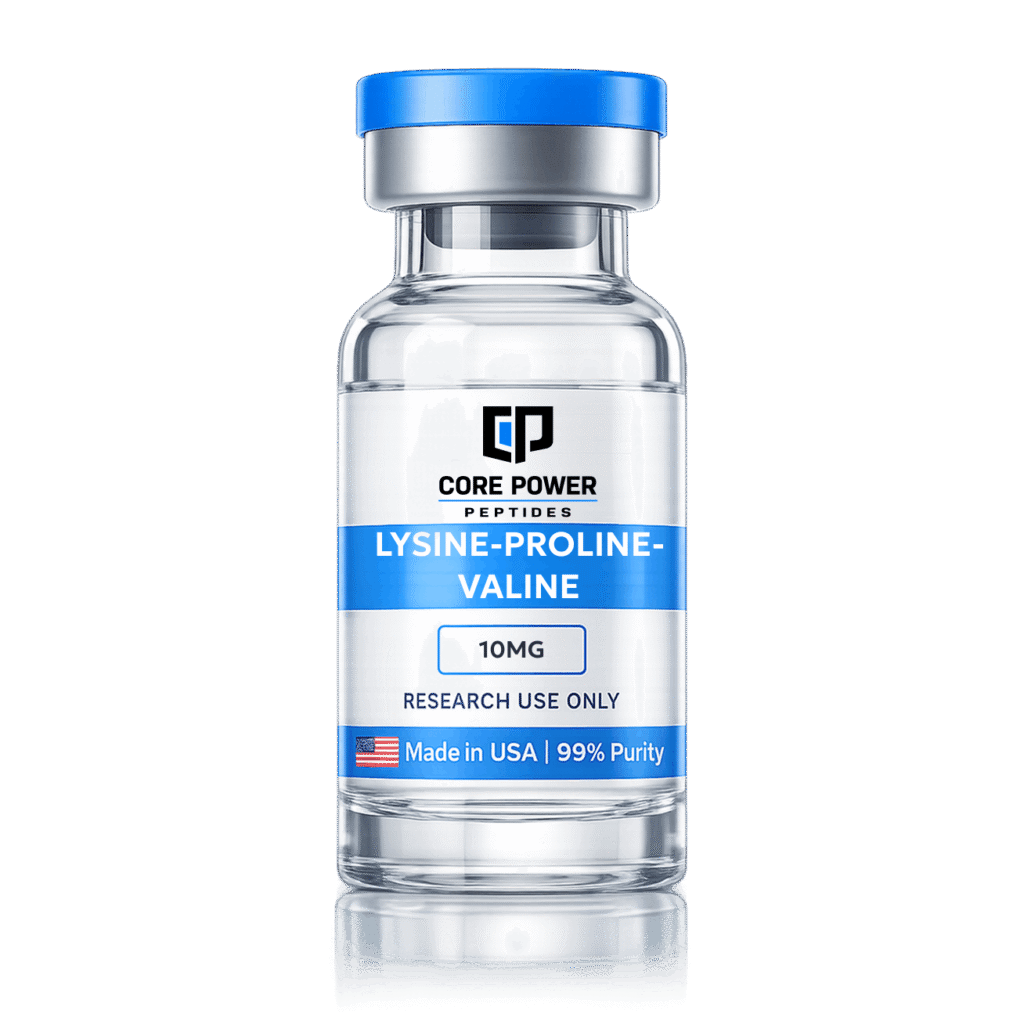
Lysine-Proline-Valine (KPV) 10mg
Purity: 99%+ HPLC
Format: Lyophilized Powder
Testing: Third-Party COA
$45
Buy Now
Frequently Asked Questions
Is KPV the same as BPC-157?
No. KPV (Lysine-Proline-Valine) is a tripeptide derived from alpha-MSH, while BPC-157 is a synthetic 15-amino acid peptide derived from gastric mucosa. They share anti-inflammatory properties but through distinct mechanisms and have different primary research applications — KPV is more focused on intestinal inflammation and melanocortin biology; BPC-157 on GI ulcer healing and tendon repair.
Is KPV water-soluble?
Yes. KPV is readily soluble in sterile water, PBS, and standard cell culture media at research concentrations. Reconstitute lyophilized powder in sterile water and store at 4°C for short-term use, or aliquot and freeze at −20°C.
What distinguishes KPV from full-length alpha-MSH?
Alpha-MSH is a 13-amino acid peptide with broad melanocortin receptor activity across MC1R, MC3R, MC4R, and MC5R. KPV is the three C-terminal amino acids and retains primarily the NF-κB inhibitory and MC1R-partial activity, without the MC3R/MC4R-mediated appetite and sexual function effects of full alpha-MSH. This selectivity is relevant for designing focused inflammation studies without confounding metabolic or behavioral effects.
Reference material for laboratory use. KPV supplied by Core Power Peptides is intended for in vitro and research applications only — not for human consumption, and not medical advice. Researchers remain responsible for applicable local regulations.