
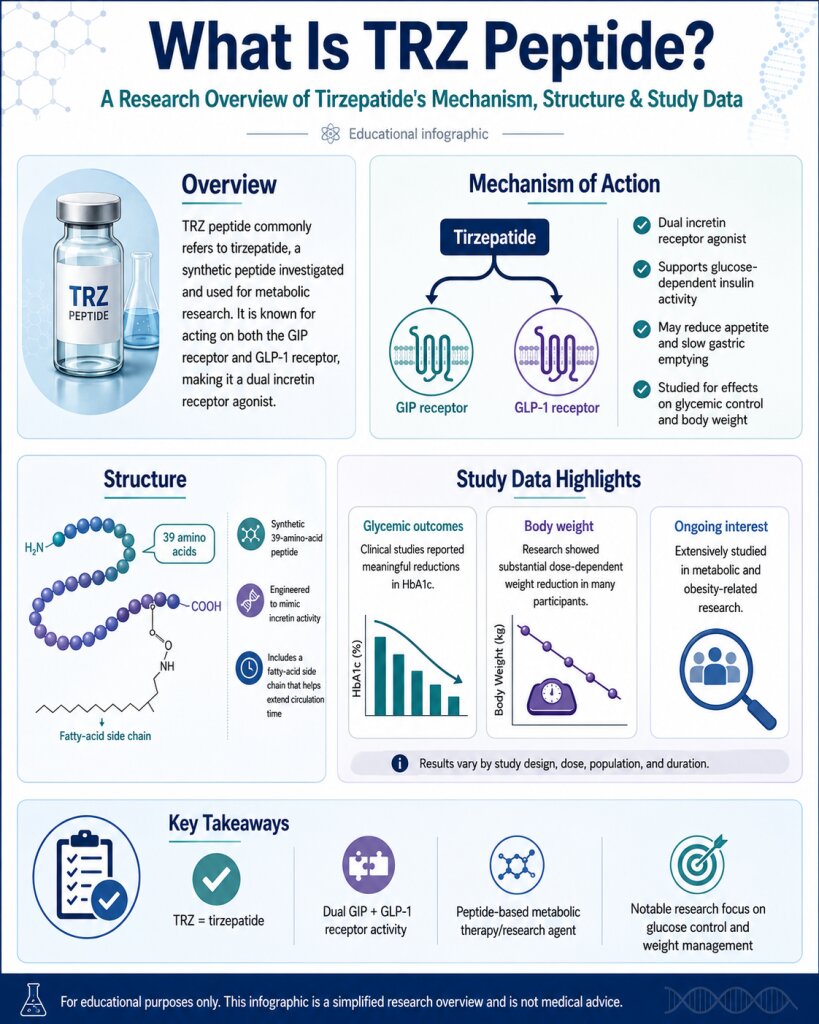
What is TRZ peptide? The term has become common shorthand across the research-peptide market for tirzepatide, one of the more extensively documented dual-receptor agonist peptides currently available to laboratory researchers. The abbreviation shows up on supplier labels, in search behavior, and increasingly in peer-reviewed literature as a compact stand-in for the full compound name. This guide covers what the term actually refers to, how the parent molecule is structured, what published research has examined, and what researchers should verify before sourcing it.
TRZ is not a separate compound — it’s an abbreviation for tirzepatide, a synthetic 39-amino-acid peptide originally developed under the compound code LY3298176. Structurally, tirzepatide is built on a modified glucose-dependent insulinotropic polypeptide (GIP) sequence with a C20 fatty di-acid moiety attached, a lipidation approach used to extend the molecule’s circulating half-life relative to earlier incretin-based peptides.
Tirzepatide functions as a dual agonist: it activates two distinct receptor systems rather than one — the GIP receptor and the glucagon-like peptide-1 (GLP-1) receptor. Both are G-protein-coupled receptors that, once activated, increase intracellular cyclic AMP through adenylyl cyclase signaling. This dual-pathway activity is the primary mechanistic distinction between tirzepatide and single-receptor GLP-1 agonists, and it’s the reason the compound has drawn sustained research attention since its introduction.
Suppliers appear to have adopted “TRZ” largely as a labeling convenience: it’s shorter than the full generic name and helps distinguish research-grade listings from the branded pharmaceutical products built on the same molecule, which are approved only in their specific licensed, prescribed form.
The abbreviation has moved quickly from supplier product listings into everyday search behavior — a pattern that tends to appear once a compound name is long enough that both sellers and researchers gravitate toward a shorter working term. As more vendors list products under the “TRZ” label directly rather than spelling out “tirzepatide” in full, search behavior has followed the labeling convention rather than the other way around. It’s a useful reminder that terminology in this space is shaped as much by how suppliers name their catalogs as by how the underlying science is described in the literature.
Researchers looking into TRZ frequently run into a second label — “TRZ-2” — used by some suppliers. It’s worth being precise here: TRZ-2 is not a recognized alternate compound or a distinct scientific designation. In practice, it functions as vendor-specific product naming, sometimes used to differentiate a listing, batch, or concentration rather than to denote a chemically different molecule.
Because naming conventions like this vary from supplier to supplier and aren’t standardized across the industry, the label on a product page shouldn’t substitute for independent verification. Any listing — whether marked TRZ, TRZ-2, or tirzepatide — should be paired with a current, lot-specific certificate of analysis (COA) confirming identity and purity via HPLC and mass spectrometry before it’s treated as reliable for research use.
Most of the research interest in tirzepatide centers on how its two receptor targets interact. GLP-1 receptor activation has been studied primarily in connection with insulin secretion and gastric emptying pathways. GIP receptor activation has been examined separately for its role in insulinotropic signaling and adipose tissue metabolism. Preclinical models suggest these two pathways may act synergistically — producing effects beyond what either receptor achieves independently — rather than simply combining additively when co-activated. That synergy hypothesis has driven a substantial share of the compound’s research literature.
This dual mechanism is also the reference point for most comparative research involving other incretin-pathway peptides, and it’s the main reason tirzepatide is classified separately from earlier-generation GLP-1 agonists in receptor-pharmacology literature.
Tirzepatide sits within a broader family of incretin-receptor-targeting peptides that researchers frequently study side by side:
Comparative research across these three generally focuses on receptor selectivity, binding affinity, and pathway synergy rather than ranking them by potency. None of the published literature establishes a settled hierarchy of “better” or “stronger” compounds — receptor engagement, structural half-life modifications, and study design all vary enough between them that direct comparisons remain an active, unresolved area of research rather than a fixed conclusion.
Tirzepatide has an unusually large clinical trial footprint for a compound of its class, with multiple Phase 1 through Phase 3 studies conducted as part of its pharmaceutical development program. That trial literature — published in journals including Diabetes Care and related endocrinology and metabolism titles — has documented findings on receptor binding affinity, insulin and glucose-regulation pathways, and gastrointestinal signaling associated with GLP-1 pathway activation, including gastrointestinal effects reported in trial populations during dose-escalation studies.
It’s an important distinction to hold onto: this trial literature describes the compound’s pharmaceutical development history and its specific, approved licensed form. It is not a description of, or claim about, the research-grade material discussed in this article, which is supplied strictly for in vitro and laboratory research and is not approved for human administration or therapeutic application outside that separate, licensed pharmaceutical context. No medical or clinical claims are made here about the research compound itself.
Because “TRZ” labeling isn’t standardized across suppliers, purity verification carries more weight here than it does with more established compound names. When evaluating a research source, look for:
A supplier willing to provide current, lot-matched documentation on request is a stronger signal of research-grade reliability than any particular label or naming convention.
Lyophilized tirzepatide is generally stored at −20°C for long-term stability. Once reconstituted, standard laboratory handling calls for storage at 2–8°C, with use limited to a short reconstitution window, and protection from repeated freeze-thaw cycling and direct light exposure — handling conditions broadly consistent with other lyophilized peptides of comparable molecular weight.
| Property | Value |
|---|---|
| Molecular formula | C₂₂₅H₃₄₈N₄₈O₆₈ |
| Molecular weight | approximately 4,813.48 Da |
| Amino acid count | 39 |
| Structural class | Modified GIP-sequence peptide with C20 fatty di-acid conjugation |
The fatty di-acid conjugation is the structural feature most frequently cited in the literature, since lipidation of this kind is a well-established method for extending peptide circulation time without altering the core receptor-binding sequence.
What is TRZ peptide? TRZ is shorthand used across the research-peptide market for tirzepatide, a synthetic 39-amino-acid dual GIP/GLP-1 receptor agonist peptide.
Is TRZ the same as tirzepatide? Yes. TRZ is an abbreviation, not a separate compound — any listing using the term should refer to the same underlying molecule.
What is TRZ-2? TRZ-2 appears to function as vendor-specific product naming rather than a distinct scientific designation. Verify it against a current certificate of analysis rather than relying on the label alone.
What has TRZ (tirzepatide) been studied for? Published research has focused on its dual GIP/GLP-1 receptor activity and associated metabolic signaling pathways — including insulin secretion, gastric emptying, and appetite-regulating hypothalamic circuits — largely within the context of its pharmaceutical development program.
How does TRZ differ from single-receptor GLP-1 peptides? Compounds like semaglutide activate only the GLP-1 receptor, while tirzepatide activates both the GIP and GLP-1 receptors. This dual-receptor mechanism is the primary distinction researchers draw, rather than any settled claim about relative potency.
Is one of these compounds better than the others for research purposes? The literature doesn’t support a fixed ranking. Selectivity, half-life, and receptor combination differ enough across semaglutide, tirzepatide, and retatrutide that comparative research in this space remains ongoing rather than concluded.
