
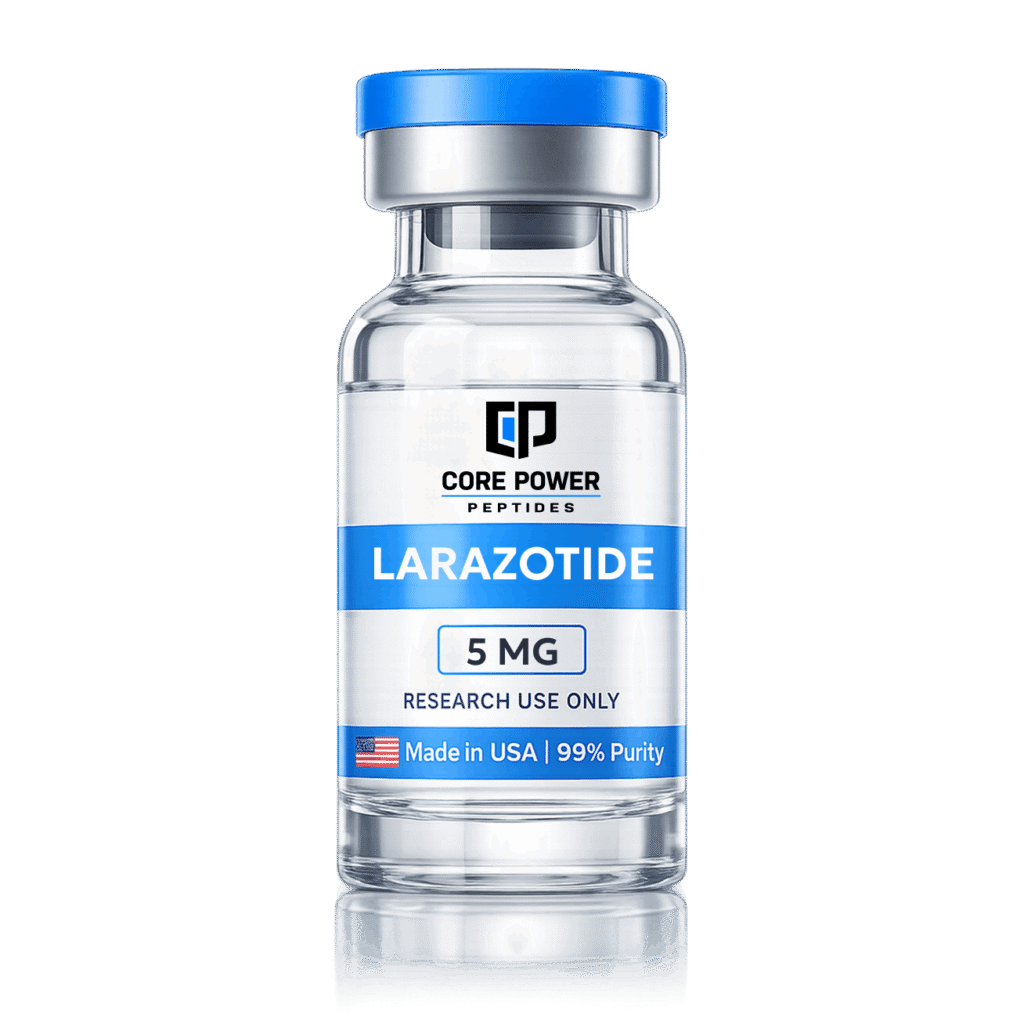
Larazotide (AT-1001) is a synthetic octapeptide that has become the most clinically advanced tight junction regulator in published research, having progressed further through human clinical trials than any other zonulin-targeting compound. Developed originally by Alba Therapeutics and now held by 9 Meters Biopharma, larazotide acts as a zonulin antagonist — blocking the molecular pathway that regulates the opening and closing of tight junctions between intestinal epithelial cells.
Search interest in “larazotide peptide” has grown substantially as gut permeability research has expanded across celiac disease, inflammatory bowel disease, and the broader gut-brain axis literature. This guide covers the mechanism, the clinical trial data behind it, and sourcing considerations for researchers.
Zonulin is a protein — identified as the precursor to haptoglobin-2 — that physiologically modulates the permeability of tight junctions in the intestinal epithelium. Under normal conditions, zonulin release is tightly regulated. However, elevated gliadin (a gluten protein) exposure, certain gut bacteria, and other triggers can cause excessive zonulin release, opening tight junctions beyond their normal regulated state. This increased permeability — colloquially termed “leaky gut” — allows larger molecules, including undigested food antigens and bacterial components, to cross the intestinal barrier and interact with the immune system.
Dysregulated zonulin signaling has been implicated in research spanning celiac disease, type 1 diabetes, multiple sclerosis, and other autoimmune and inflammatory conditions where increased intestinal permeability is thought to play a mechanistic role.
The pivotal study establishing larazotide’s research profile was a Phase 2b randomized, double-blind, placebo-controlled trial in celiac disease patients who remained symptomatic despite adherence to a gluten-free diet. Key findings:
| Property | Value |
|---|---|
| Classification | Synthetic octapeptide |
| Target | Zonulin pathway / tight junction regulation |
| Molecular Weight | 825.9 Da |
| Developer | Alba Therapeutics (now 9 Meters Biopharma) |
| Highest trial phase | Phase 2b (celiac disease) |
| Systemic absorption | Minimal — designed for local gut action |
| Context | Dose | Route | Notes |
|---|---|---|---|
| Phase 2b clinical trial | 0.5mg | Oral | 3× daily |
| In vitro (Caco-2 permeability models) | 1–100 µM | Apical media | TEER and paracellular flux assays |
| Rodent gut permeability models | 0.1–1 mg/kg | Oral gavage | Zonulin-challenge protocols |
Research reference only. Not dosing guidance for human use.
| Compound | Mechanism | Clinical Stage |
|---|---|---|
| Larazotide (AT-1001) | Zonulin receptor antagonist | Phase 2b (most advanced) |
| BPC-157 | NO/VEGF-mediated epithelial repair | Preclinical (extensive rodent data) |
| KPV (Lysine-Proline-Valine) | NF-κB suppression, barrier protein upregulation | Preclinical |
Larazotide is mechanistically distinct from BPC-157 and KPV — it specifically blocks the zonulin pathway that opens tight junctions, whereas BPC-157 and KPV act more broadly on inflammation and epithelial repair. Researchers studying gut barrier integrity from a zonulin-specific angle typically select larazotide; those studying broader mucosal healing or inflammation often use BPC-157 or KPV, and some protocols combine mechanisms.
Sourcing criteria for research-grade larazotide:
Larazotide is used as a research tool to investigate the role of the zonulin pathway and intestinal tight junction permeability in disease models — primarily celiac disease, but also inflammatory bowel disease, non-celiac gluten sensitivity, and gut-brain axis research. It has reached Phase 2b clinical trials, the most advanced stage of any published zonulin antagonist.
No. Larazotide does not break down or neutralize gluten. It works downstream of gluten exposure by blocking the zonulin-mediated tight junction opening that allows gluten peptides and other antigens to cross the intestinal barrier. It addresses the permeability response, not the gluten itself.
In the Phase 2b trial, larazotide reduced symptoms in celiac patients who were already following a strict gluten-free diet — meaning it addressed residual gut permeability-driven symptoms that diet alone did not resolve. This positions it as a potential complement to, not a replacement for, dietary gluten avoidance in research contexts.
Provided as educational and scientific reference. Larazotide is not approved for human use outside of clinical trials; material from Core Power Peptides is supplied strictly for in vitro and laboratory research, and researchers remain responsible for applicable local regulations.
