Written by the Core Power Peptides Research Team — biochemists and laboratory specialists compiling and verifying peptide research data. Learn about our quality standards →
Epitalon emerged from a distinctly Russian line of research: Vladimir Khavinson’s work at the Institute of Biogerontology in St. Petersburg on pineal peptide bioregulators, now spanning more than 30 years. Its central claim is unusually specific for an aging compound — direct activation of telomerase, the enzyme maintaining the telomere length that functions as a molecular clock of cellular aging.
Epithalamine (Epitalon): A Synthetic Pineal Tetrapeptide
Epithalamine — known in research literature as epitalon or epithalon — is a synthetic tetrapeptide (Ala-Glu-Asp-Gly) developed by the research team of Vladimir Khavinson at the Institute of Biogerontology, St. Petersburg, based on the active peptide fraction of the natural pineal gland extract epithalamin. As a synthetic analog of the pineal bioregulator, epitalon has been studied for over 30 years in the context of aging biology, with particular emphasis on its ability to activate telomerase — the enzyme responsible for maintaining telomere length, the molecular clock of cellular aging.
Search volume for “epithalamine tablets” and related terms reflects consistent research interest, with the compound occupying a unique niche as a peptide bioregulator with documented effects on telomerase, melatonin production, and lifespan in multiple model organisms.
Mechanism of Action
- Telomerase Activation: Upregulates TERT (telomerase reverse transcriptase) gene expression, increasing telomerase enzymatic activity — documented in multiple cell lines including human somatic cells and fibroblasts
- Telomere Elongation: Telomerase activation enables telomere length maintenance or restoration in cells approaching senescence, a mechanism directly relevant to the Hayflick limit and cellular aging
- Pineal Gland Regulation: Influences pineal epithelial cell function, restoring age-related decline in melatonin production — the primary geroprotective hormone of the pineal gland
- Antioxidant Induction: Increases superoxide dismutase (SOD) and glutathione peroxidase activity, reducing oxidative stress burden at the cellular level
- Circadian Rhythm Restoration: Through melatonin normalization, supports circadian gene expression (CLOCK, BMAL1) whose dysregulation accelerates aging
- Gene Expression: Downregulates pro-inflammatory and oncogene-associated transcripts; upregulates DNA repair and longevity-associated gene expression
Key Research Data
Telomerase and Telomere Research
- Khavinson et al. (Bulletin of Experimental Biology and Medicine, 2003): Epitalon increased telomerase activity in human fetal fibroblasts and somatic cells by ~33% vs. control cultures
- Extended replicative lifespan of human cell cultures by 3–4 additional cell divisions beyond normal Hayflick limit
- Significant telomere lengthening documented in epitalon-treated cell populations vs. untreated aging controls
Longevity Studies in Model Organisms
- Melanocyte mouse model: Epitalon extended maximum lifespan by ~25% and increased average lifespan by ~13% vs. controls
- Rat studies (Khavinson et al.): Epitalon-treated rats showed 28-33% reduction in cancer incidence, improved estrous cycle maintenance with aging, and reduced chromosomal aberration rates
- Drosophila melanogaster: Epitalon extended median lifespan by ~11% in multiple independent experiments
Melatonin and Circadian Research
- Restored nocturnal melatonin secretion peaks in aged rodents to levels comparable to young adults
- Normalized disrupted circadian cortisol rhythms in aged models
- Melatonin normalization correlated with improved immune function markers in aging studies
Oncology-Adjacent Research
- Reduced spontaneous mammary tumor incidence in HER-2/neu transgenic mice
- Attenuated carcinogen-induced colon tumorigenesis in rodent models
- Proposed mechanism: melatonin restoration reduces estrogen-driven tumor promotion
Dosage Reference for Research
| Research Context |
Dose |
Route |
Duration |
| Cell culture (telomerase) |
0.1–10 µM |
Culture media |
Acute or multi-day |
| Rodent (longevity) |
0.1–1 mg/kg |
SC injection |
10-day courses, repeated |
| Russian clinical protocols |
10 mg/day |
SC or IM |
10 consecutive days, 1–2×/year |
Epitalon Research Products
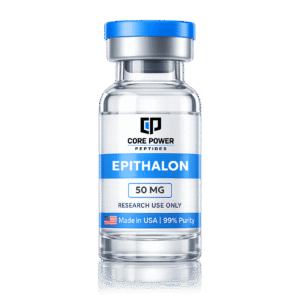
HPLC Verified
Epithalon (Epitalon) 50mg
Purity: 99%+ HPLC
Format: Lyophilized Powder
Testing: Third-Party COA
$480
Buy Now
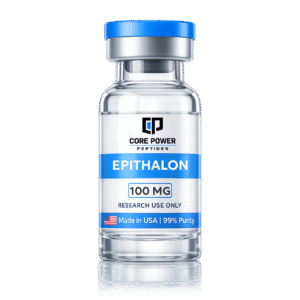
HPLC Verified
Epithalon (Epitalon) 100mg
Purity: 99%+ HPLC
Format: Bulk Lyophilized
Testing: Third-Party COA
$900
Buy Now
Frequently Asked Questions
What does the telomerase data actually show?
Khavinson et al. (2003) reported roughly 33% increased telomerase activity in human fetal fibroblasts and somatic cells versus control cultures, with replicative lifespan extended by 3–4 additional cell divisions beyond the normal Hayflick limit and measurable telomere lengthening in treated populations.
Is epitalon the same as epithalamin?
Not quite. Epithalamin is the natural pineal gland extract; epitalon (also written epithalon) is the synthetic tetrapeptide Ala-Glu-Asp-Gly developed from its active peptide fraction. The synthetic version is what appears in current research.
Why is melatonin discussed alongside telomerase in this research?
Because epitalon acts on pineal epithelial cell function, restoring age-related decline in melatonin production. Since melatonin is the pineal gland’s primary geroprotective hormone and regulates circadian gene expression, the two mechanisms are treated as linked in the longevity literature rather than separate.
Compiled as scientific reference. Epithalon from Core Power Peptides is supplied for in vitro and laboratory research exclusively — not for human consumption, and not medical guidance.

