Written by the Core Power Peptides Research Team — biochemists and laboratory specialists compiling and verifying peptide research data. Learn about our quality standards →
The most dramatic demonstrations in muscle biology tend to come from removing a brake rather than adding an accelerator. Follistatin 344 is that brake removal — it binds and neutralizes myostatin with sub-nanomolar affinity, and systemic overexpression in mice has produced 100–200% increases in muscle mass, roughly double what myostatin knockout alone achieves.
Follistatin 344: The 344-Isoform and Why It Matters
Follistatin 344 is the 344-amino acid isoform of follistatin (FST), a secreted glycoprotein that functions as a potent endogenous antagonist of transforming growth factor-β (TGF-β) superfamily ligands — most critically myostatin (GDF-8), activin A, and activin B. Through high-affinity binding and neutralization of these growth-inhibiting signaling molecules, follistatin 344 exerts powerful pro-myogenic effects in skeletal muscle tissue, making it one of the most studied proteins in muscle physiology and therapeutic muscle biology research.
The 344-isoform is particularly relevant for systemic muscle research because, unlike the shorter 288 isoform (which is heparin-bound and tends to remain local to the gonads), FST344 circulates freely and acts systemically on muscle, bone, and other tissues. The dramatic muscle hypertrophy observed in myostatin-knockout “double-muscled” cattle and in follistatin-overexpressing mice has established the myostatin/follistatin axis as one of the most important levers in muscle biology.
Mechanism of Action
- Myostatin (GDF-8) Neutralization: Binds myostatin with sub-nanomolar affinity (Kd ~0.3 nM), forming an inactive complex that prevents myostatin from signaling through its ActRII receptors — the primary mechanism of FST344’s pro-hypertrophic effect
- Activin A/B Antagonism: Inhibits activin signaling that suppresses muscle protein synthesis and promotes atrophy; also relevant for fertility and reproductive biology research
- BMP Regulation: Modulates bone morphogenetic protein (BMP) signaling, influencing bone metabolism and differentiation
- Satellite Cell Activation: By relieving myostatin suppression, FST344 promotes activation and proliferation of muscle satellite cells (muscle stem cells) — the cellular basis for hypertrophic adaptation
- mTOR Pathway Activation: Downstream Smad2/3 inhibition (normally activated by myostatin) leads to increased mTOR activity and protein synthesis rate
Key Research Data
Muscle Hypertrophy Models
- Lee & McPherron (PNAS, 2001): Systemic FST overexpression in mice produced 100–200% increase in muscle mass — approximately double the effect of myostatin knockout alone, due to FST’s additional activin A inhibition
- Guo et al. (Molecular Therapy, 2012): AAV-mediated FST344 delivery to aged mice restored muscle mass and strength to young adult levels within 8 weeks
- Short-term protein administration studies: Recombinant FST344 injection increased muscle wet weight by 15–25% in rodent models within 2–3 weeks
Muscular Dystrophy Research
- FST344 gene therapy significantly improved muscle strength, histology, and diaphragm function in mdx (Duchenne muscular dystrophy) mouse models
- Reduced necrosis and fibrosis in dystrophic muscle with FST344 overexpression
- Clinical translation efforts underway for Becker and Duchenne muscular dystrophy
Sarcopenia and Aging Research
- Myostatin levels increase with age while circulating follistatin declines — the inverse relationship contributes to sarcopenic muscle loss
- Exogenous FST344 administration in aged rodents reversed atrophy markers and improved grip strength
- Identified as a primary mechanism for exercise-induced muscle maintenance in the elderly
Follistatin 344 Dosage Reference for Research
| Research Context |
Dose |
Route |
Notes |
| In vitro (C2C12 myotubes) |
10–100 ng/mL |
Culture media |
Myostatin neutralization, differentiation |
| Rodent (systemic) |
1–5 µg/kg/day |
SC or IP |
Hypertrophy protocols, 2–4 weeks |
| Rodent (local IM) |
0.1–1 µg/muscle |
Intramuscular |
Site-specific hypertrophy studies |
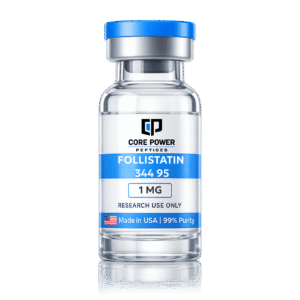
95%+ HPLC
Follistatin 344 — 1mg
Purity: 95%+ HPLC
Format: Lyophilized Powder
Testing: Third-Party COA
$280
Buy Now
Frequently Asked Questions
Why the 344 isoform specifically?
Circulation. The shorter 288 isoform is heparin-bound and tends to remain local to the gonads, whereas FST344 circulates freely and acts systemically on muscle, bone, and other tissues — which is what makes it the relevant isoform for systemic muscle research.
How does follistatin relate to myostatin in research protocols?
They are functional opposites and are typically studied as a pair. Recombinant myostatin is used to induce atrophy or establish a signaling baseline; follistatin 344 is used to neutralize it. The balance between the two circulating proteins is itself a primary determinant of muscle mass.
Why does follistatin outperform myostatin knockout in some models?
Because it inhibits more than myostatin alone. FST344 also antagonizes activin A and activin B, which independently suppress muscle protein synthesis — so removing both signals produces a larger effect than removing myostatin by itself.
Provided as laboratory reference. Follistatin 344 is supplied by Core Power Peptides for in vitro and research applications only — not for human consumption, and not medical advice.

