Written by the Core Power Peptides Research Team — biochemists and laboratory specialists compiling and verifying peptide research data. Learn about our quality standards →
Loren Pickart isolated GHK-Cu from human plasma in 1973, and more than five decades later it remains one of the most mechanistically characterized peptides in regenerative biology — a 2009 microarray analysis found it modulates over 4,000 human genes. What makes it unusual among research peptides is breadth: dermatology, wound healing, neuroscience, and aging biology all draw on the same compound.
GHK-Cu: A Copper-Binding Tripeptide
GHK-Cu (glycine-histidine-lysine copper complex) is a naturally occurring tripeptide-copper(II) chelate first isolated from human plasma by Loren Pickart in 1973. Present at high concentrations in blood, saliva, and urine in youth (~200 ng/mL at age 20), serum GHK levels decline markedly with age (~80 ng/mL by age 60), a pattern that has led geroscience researchers to study GHK-Cu as a potential mediator of the aging-related decline in tissue repair capacity.
GHK-Cu has accumulated an unusually broad research profile across dermatology, wound healing, neuroscience, and aging biology, making it one of the most versatile research peptides available. Over 50 published studies document its biological activities across multiple tissue types.
Mechanism of Action
- Collagen Synthesis: Upregulates collagen I, III, and IV production in fibroblasts; activates collagen-encoding genes via TGF-β pathway modulation
- Matrix Metalloproteinase Regulation: Promotes remodeling balance — increases MMP activity while also inducing TIMP (tissue inhibitor of metalloproteinase) expression
- Growth Factor Modulation: Amplifies effects of TGF-β1, FGF, VEGF, and NGF in tissue repair models
- Antioxidant Activity: Copper cofactor contributes superoxide dismutase-like activity; reduces 8-OHdG DNA oxidation markers
- Anti-inflammatory: Inhibits NF-κB activation and downregulates TNF-α, IL-6, and IL-1β production
- Gene Expression: A 2009 microarray analysis (Pickart et al.) found GHK-Cu modulates over 4,000 human genes — activating wound repair genes and suppressing inflammatory and cancer-related gene expression
- Neurotrophin Support: Increases NGF and BDNF expression in neural tissue models
Research Applications and Data
Wound Healing
- Accelerated wound closure by 20–30% in rodent excision wound models
- Enhanced granulation tissue formation and re-epithelialization rate
- Improved collagen deposition quality (increased collagen cross-linking density)
Skin Aging and Dermatology
- Increased skin thickness and elasticity in human clinical studies (Leyden et al.)
- Improved photoaging scores including fine lines, wrinkle depth, and skin density
- Reduced hyperpigmentation and improved skin texture in clinical assessments
Hair Follicle Research
- Stimulates hair follicle enlargement and elongation in organ culture models
- Increases keratinocyte proliferation in follicular epithelium
- Shifts follicle cycling toward the anagen (growth) phase in mouse models
Neuroscience Applications
- NGF upregulation supports peripheral nerve regeneration models
- BDNF effects documented in hippocampal cell culture studies
- Neuroprotective effects against oxidative stress-induced neuronal death
Aging and Longevity Research
- Downregulates “cancer-like” and “inflammation-like” gene expression clusters in aged tissues
- Reverses many age-associated gene expression changes in human fibroblasts in vitro
- Increases Nrf2 target gene expression, activating endogenous antioxidant programs
Dosage Reference for Research
| Research Context |
Concentration / Dose |
Route |
| In vitro fibroblast studies |
1–100 nM |
Cell culture media |
| Wound healing (rodent) |
1–10 µg/cm² wound area |
Topical or SC peri-wound |
| Hair follicle organ culture |
10–1000 nM |
Culture media |
| Human clinical (skin aging) |
0.1–1% topical formulation |
Topical |
Where to Buy GHK-Cu for Research
Sourcing criteria for research-grade GHK-Cu:
- HPLC purity ≥99% to confirm copper-peptide complex integrity
- Mass spectrometry verification of the Cu²⁺ chelate (not free peptide alone)
- Endotoxin testing for cell culture applications
- Lyophilized powder for long-term stability; reconstitute in aqueous buffer for in vitro use
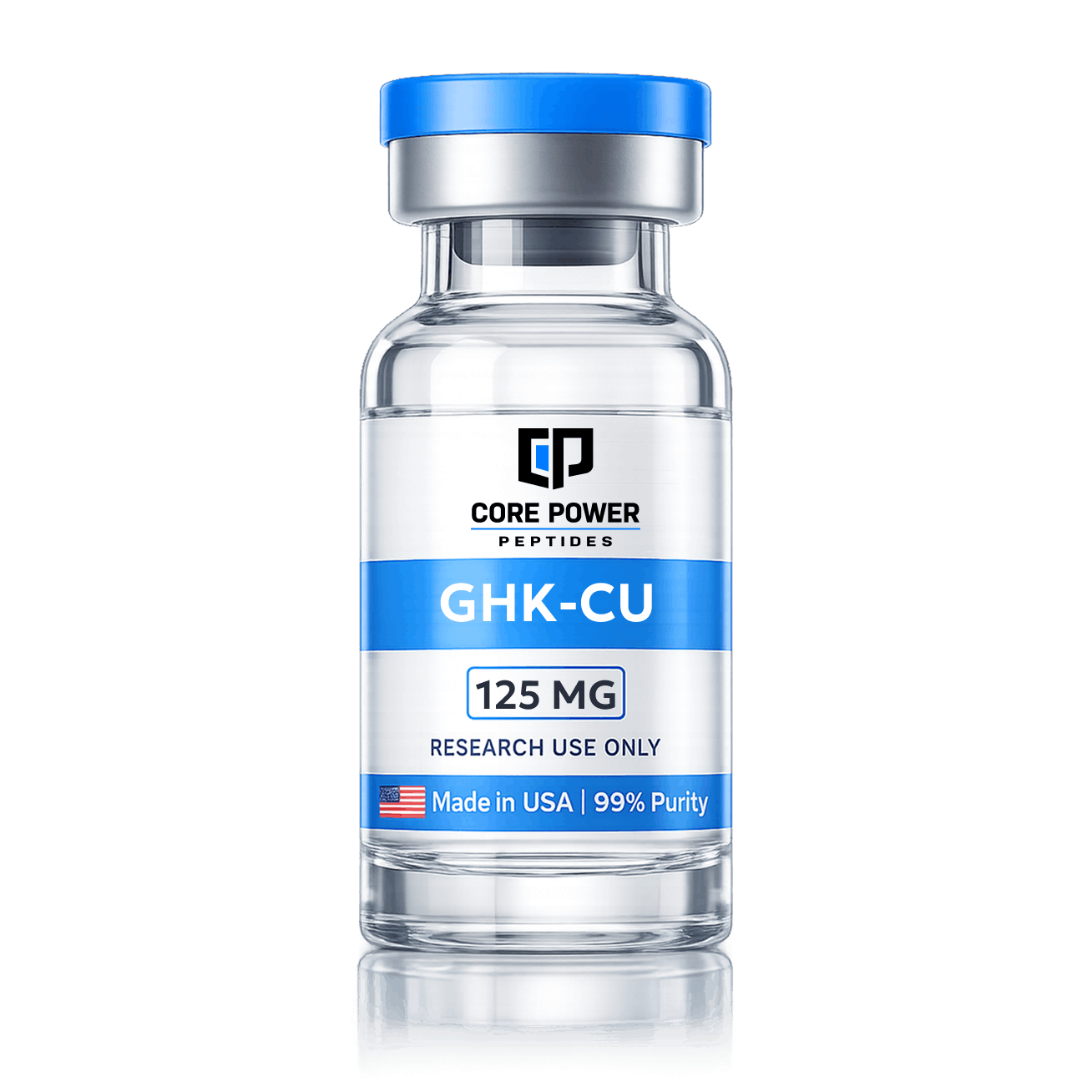 HPLC Verified
GHK-Cu 125mg
Purity: 99%+ HPLC
Format: Lyophilized Powder
Testing: Third-Party COA
$220
Buy Now
Frequently Asked Questions
How does GHK-Cu compare to BPC-157 for tissue repair research?
They operate through largely non-overlapping mechanisms. GHK-Cu drives collagen synthesis and matrix remodeling directly, with copper acting as an antioxidant cofactor. BPC-157 works primarily through nitric oxide signaling and growth factor upregulation — the BPC-157 and TB-500 stack guide covers that mechanism in detail. Researchers studying extracellular matrix quality specifically tend to select GHK-Cu.
Why is the copper complex important — can free GHK be substituted?
No. The copper(II) chelate is integral to the mechanism, contributing superoxide dismutase-like antioxidant activity the free peptide does not provide. This is precisely why mass spectrometry verification of the Cu²⁺ complex — not just peptide identity — matters when sourcing.
What concentrations appear in published fibroblast work?
In vitro fibroblast studies typically use the 1–100 nM range in culture media. Hair follicle organ culture protocols generally run higher, around 10–1000 nM.
This material is intended for in vitro and laboratory research only. Core Power Peptides does not supply GHK-Cu for human use, and none of the research summarized here constitutes medical guidance.

