
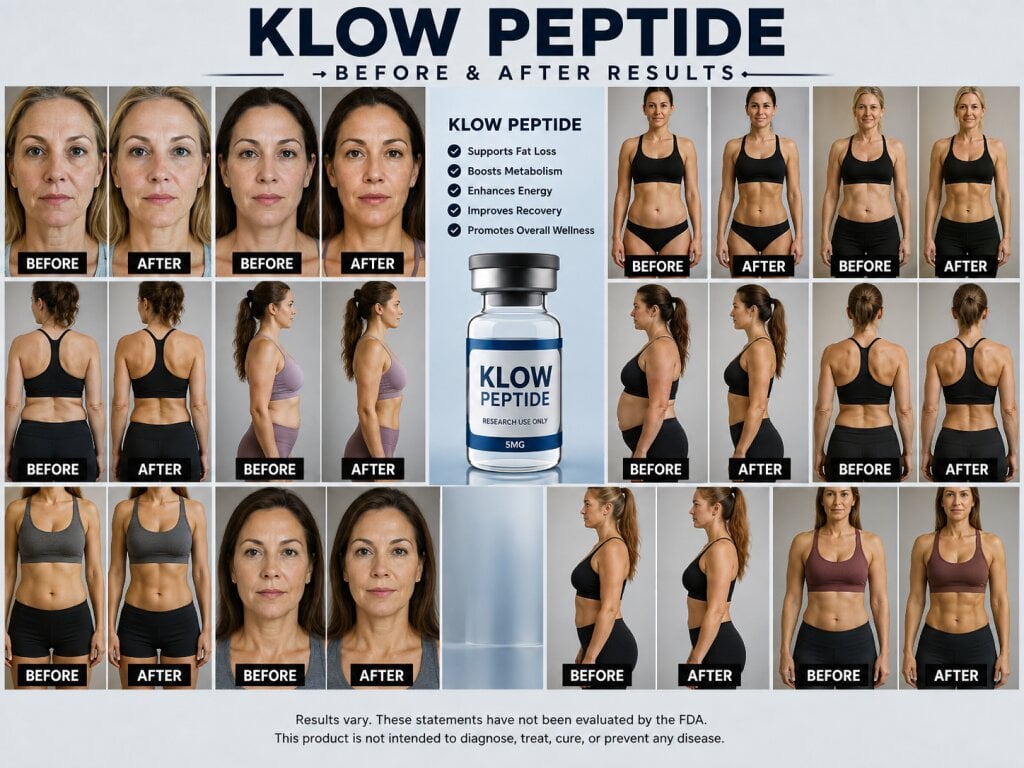
Klow peptide before and after searches specific to women cluster around two distinct outcome areas — facial skin and hair — and the evidence base for each is meaningfully different, which is worth understanding before comparing your own research timeline against what’s circulating online. Klow combines GHK-Cu, BPC-157, TB-500, and KPV in a single formulation, with GHK-Cu (the largest component by weight) doing most of the mechanistic work behind both the facial and hair-related outcomes. This guide covers the realistic timeline for each area, what’s genuinely documented versus overstated, and real reported experiences, for research purposes only. Klow research protocols referenced throughout are for laboratory use only.
Real reported experiences and community documentation consistently place facial skin changes in a specific window. Early subtle changes — improved skin feel and faster healing from minor irritation — are commonly reported around weeks 2-3. More visible facial changes, including improved tone evenness and softened fine surface lines, are typically reported in the weeks 3-6 range, tracking with GHK-Cu’s studied role in collagen and elastin synthesis. Reports describing dramatic 2-week transformations should be read skeptically against this broader pattern — most consistent, sustained facial changes take longer than that.
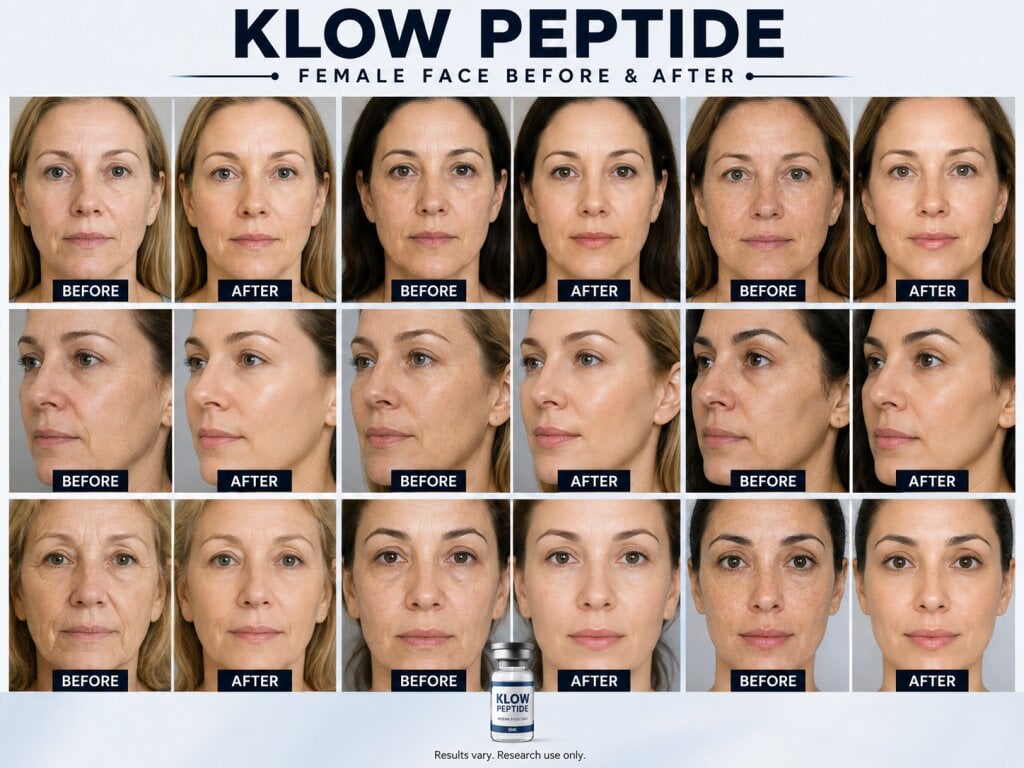
One of the more clinically interesting developments here is a published protocol from a plastic surgery practice using GLOW and KLOW specifically as part of structured post-operative recovery — notably specifying GLOW (the simpler, non-KPV version) for facelift, neck lift, and blepharoplasty recovery, while reserving KLOW for procedures involving a larger surgical field like body contouring, where KPV’s added anti-inflammatory action is more relevant. This matters directly for the “female face” search intent, since facelift and blepharoplasty are procedures overwhelmingly searched and undergone by women — and it suggests GLOW, not Klow, may actually be the more directly applicable blend for facial-only research specifically.
Real reports — face:
This needs to be stated plainly: there is no strong clinical proof that GHK-Cu regrows hair as a standalone treatment. Its documented strength is improving the scalp and follicle environment — circulation, extracellular matrix support, growth-factor signaling — rather than directly driving new follicle growth the way an approved treatment like minoxidil is designed to. TB-500’s hair-related data is even thinner, coming almost entirely from animal studies with essentially no controlled human trials specific to hair. Realistic outcomes lean toward reduced shedding and improved hair quality rather than dramatic regrowth, and hair-related changes are consistently the slowest of Klow’s outcomes — commonly 8-16 weeks minimum, mirroring the multi-month evaluation windows used for approved hair therapies generally.

One useful context point specific to women: rapid weight loss from GLP-class compounds (sometimes stacked alongside Klow) can trigger temporary hair shedding known as telogen effluvium. Some research protocols pair Klow with weight-loss compounds specifically to use GHK-Cu’s follicle-supporting mechanism as a hedge against that shedding, rather than as a standalone growth strategy — meaning some “before and after” hair content circulating for Klow may actually be documenting recovery from a temporary shedding event rather than new growth from an untouched baseline.
Real reports — hair:
Since GHK-Cu, BPC-157, and TB-500 are dosed identically in both blends, the practical difference for skin and hair outcomes is close to nonexistent — you’d struggle to distinguish which blend produced a given result at equivalent timepoints. KPV, the ingredient exclusive to Klow, is specifically an anti-inflammatory addition. That means the decision between the two isn’t really a “which is better for women” question — it’s a “does your research interest include an inflammation-focused component or not” question, and the published surgical-recovery protocol above suggests GLOW may actually be the more relevant choice for facial-only research specifically.
Facial skin is one of the most visually scrutinized applications for any peptide blend, meaning inconsistent sourcing shows up faster and more obviously here than in less visible applications. Hair outcomes are the opposite problem — the effect is already modest and slow by nature, which makes it exactly the kind of result that’s easiest to lose entirely to an underdosed GHK-Cu component. In both cases, verifying that all four ingredients in a Klow batch are accurately dosed — not just broadly “pure” — is directly relevant to getting a result that matches the real reports above rather than falling short of them.
How long does Klow take to show facial results in women? Early changes like improved skin feel are commonly reported around weeks 2-3, with more visible tone and texture changes typically developing over weeks 3-6.
Does Klow regrow hair in women? There’s no strong clinical evidence that GHK-Cu, Klow’s primary hair-relevant component, regrows hair as a standalone treatment. Realistic outcomes lean toward reduced shedding and improved hair quality, typically over 8-16 weeks minimum.
Is Klow or Glow better for women specifically? Neither is inherently “for women” — the choice depends on whether an inflammation-focused component (KPV) is relevant to your research interest. A published surgical-recovery protocol specifically uses GLOW rather than Klow for facial-only procedures.
Why does hair shedding sometimes appear alongside Klow use? Rapid weight loss from separately stacked compounds can trigger temporary shedding (telogen effluvium) independent of Klow. Some protocols use Klow’s GHK-Cu component to help offset this rather than as a standalone growth strategy.
The female-specific data around Klow splits into two genuinely different evidence pictures: facial skin changes are reasonably well-supported by GHK-Cu’s collagen mechanism and show up in a realistic 2-6 week window, while hair-related claims are thinner, slower (8-16 weeks minimum), and should be framed around reduced shedding rather than dramatic regrowth. A published clinical protocol specifically favors GLOW over Klow for facial-only procedures, which is worth knowing before assuming Klow is the default “face” version. Explore the full peptide research catalog at Core Power Peptides for COA-verified GHK-Cu, BPC-157, TB-500, and KPV.
Search interest in Klow has generated a steady volume of face, skin, and hair content across TikTok, YouTube, and Instagram, largely echoing the patterns described above rather than introducing anything new.
As with the reports above, the outcomes and timelines described across these vary by poster and skew toward the more visible weeks 3+ window — treat any tag or video promising dramatic results in days as an outlier rather than the norm. For the exact ratio referenced throughout, see the Core Power Peptides KLOW 80 listing.
This article is for informational and educational purposes only. GHK-Cu, BPC-157, TB-500, KPV, and all products referenced are intended strictly for laboratory research use and are not approved for human consumption, diagnosis, treatment, or prevention of any disease. Nothing in this article constitutes medical advice or a recommendation regarding surgical recovery protocols; consult a licensed medical provider for any post-surgical care decisions.
Klow is a four-peptide blend combining GHK-Cu, BPC-157, TB-500, and KPV in a single vial, typically at an 80mg total ratio of 50mg GHK-Cu, 10mg BPC-157, 10mg TB-500, and 10mg KPV. It’s essentially the “Glow” blend (GHK-Cu + BPC-157 + TB-500) with one addition — KPV, an anti-inflammatory tripeptide — which is the entire distinction between the two names. This guide covers the realistic timeline by outcome, what separates Klow from Glow, and real reported experiences, for research purposes only.
Community-reported timelines across the four target areas follow a fairly consistent pattern, since each ingredient contributes a distinct mechanism on its own schedule:
The distinction between Klow and Glow is exactly one ingredient — KPV, a tripeptide derived from a fragment of alpha-melanocyte-stimulating hormone. For GHK-Cu, BPC-157, and TB-500, the dose and expected outcomes are identical between the two blends; the difference is entirely about the added anti-inflammatory pathway KPV brings, which works through a different mechanism (NF-κB inhibition) than the tissue-repair-focused pathways the other three peptides rely on. In practical terms: if the research interest is primarily skin and general tissue repair, Glow and Klow perform nearly identically. If chronic inflammation, gut-related concerns, or a generally elevated inflammatory profile are the specific research focus, Klow’s added KPV component is the more directly relevant formulation.
YouTube
Community reviews
Klow compounds the sourcing risk further than even a two-peptide stack like the Wolverine Stack — with four separate active ingredients in one vial, verifying accurate ratios (not just purity) becomes critical. A blend where any one of the four components is underdosed relative to the others won’t necessarily show up as an obvious problem; it just quietly produces an inconsistent or incomplete result. This is a case where a supplier’s batch-specific Certificate of Analysis needs to confirm all four components individually, not just an overall purity percentage.
What is Klow peptide?
Klow is a four-peptide blend combining GHK-Cu, BPC-157, TB-500, and KPV, typically at an 80mg total ratio, designed for tissue repair, skin, and inflammation-related research.
How is Klow different from Glow?
Klow contains everything in the Glow blend (GHK-Cu, BPC-157, TB-500) plus KPV, an anti-inflammatory tripeptide. The other three components are dosed identically between the two.
How long does it take to see results from Klow?
Wound and scar-related changes are reported earliest, around weeks 2-4. Skin texture changes are commonly reported around weeks 3-6. Hair-related changes are the slowest and least consistently supported, often 8-16 weeks or more.
Is Klow better than Glow?
Not universally — for skin and general tissue repair, the two perform nearly identically since three of the four ingredients are shared at the same dose. Klow is the more relevant choice specifically when inflammation is a distinct research focus.
Klow’s before-and-after picture is really four separate timelines layered together — wound healing moving fastest, skin texture following a few weeks behind, and hair-related changes trailing well behind both. The KPV addition is the entire practical difference from the Glow blend, and it’s a meaningful one specifically for inflammation-focused research rather than a generic upgrade. Given the four-component complexity, verified per-ingredient sourcing matters more here than with any single-compound or even two-compound protocol. Explore the full peptide research catalog at Core Power Peptides for COA-verified GHK-Cu, BPC-157, TB-500, and KPV.
This article is for informational and educational purposes only. GHK-Cu, BPC-157, TB-500, KPV, and all products referenced are intended strictly for laboratory research use and are not approved for human consumption, diagnosis, treatment, or prevention of any disease.
