
Written by: — Valeria Marulanda
The last 18 months have been rough for the research-peptide vendor market. One major supplier had its warehouse raided by the FDA. Another shut down overnight with no explanation and no refunds. A third’s owner was sentenced to nearly six years in federal prison for, among other things, forging Certificates of Analysis. If you’re trying to figure out which vendor is actually reliable, “best peptide vendor” isn’t a shopping preference right now, it’s risk management.
This guide doesn’t rank ten vendors and declare a winner. Most “best peptide vendors” listicles do exactly that, often written by the vendor being ranked #1, which is worth noticing on its own. Instead, this covers what actually happened to the vendors that failed, the specific criteria that separate a verifiable vendor from an unverifiable one, and where to check any vendor, including Core Power Peptides, the company publishing this guide, against those criteria yourself.

Key Takeaways
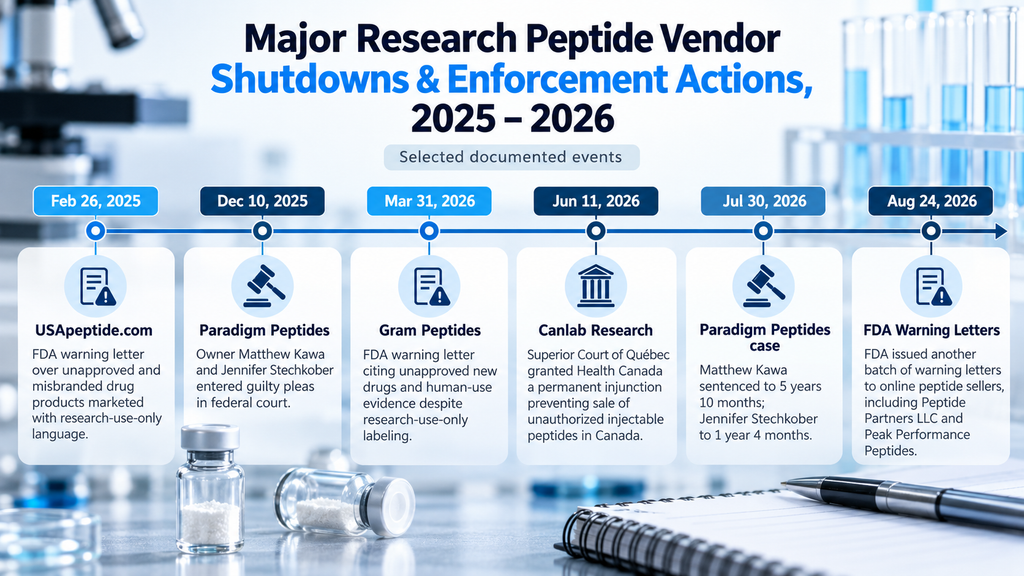
- Three major peptide vendors shut down or faced serious legal consequences in the past 18 months: Amino Asylum (FDA warehouse raid, June 2025), Peptide Sciences (abrupt voluntary shutdown, March 2026, after a decade in business), and Paradigm Peptides (owner sentenced to nearly six years in federal prison in 2026 for selling unapproved, mislabeled drugs and forging Certificates of Analysis).
- The evaluation criteria that actually hold up under scrutiny are specific: lot-matched COAs with real chromatogram and mass-spec data, independently verifiable lab accreditation, a consistent review history over time rather than a single aggregate score, and a track record free of the enforcement patterns above.
- Even vendors currently ranked #1 by some review sites show real gaps under more rigorous independent audit, one widely-cited “top” vendor holds a perfect score on one review site but ranks #15 of 55 on another site’s stricter audit, which specifically flagged missing lab accreditation documentation. No single “best of” list should be taken as the final word.
- Iron Peptides is the publisher of this guide and is described below against the same criteria as everyone else, not as a competitor ranking itself first.
For Research Use Only. Not for human or veterinary use. This article is for educational and informational purposes only and does not constitute medical, legal, or financial advice.
Amino Asylum was, before mid-2025, one of the most-visited peptide and research-chemical peptide vendors in the US, reportedly drawing over 400,000 monthly visitors. Federal authorities raided its Memphis, Tennessee warehouse on or around June 18, 2025. The site went offline within days; payment processing was terminated and pending orders were frozen. Reporting on the raid attributes it to the company ignoring multiple prior FDA warning letters, marketing products for human consumption despite “research use only” labeling, and selling prescription-only medications without a pharmacy license.
Paradigm Peptides, based in Michigan City, Indiana, sold peptides, HCG, and SARMs to an estimated 54,000 customers across all 50 states and 80 countries. According to the Department of Justice, owner Matthew Kawa pleaded guilty to selling unapproved drugs and illegally importing them, and was sentenced in 2026 to nearly six years in federal prison; a co-defendant received 16 months. Court records describe products marketed as SARMs that actually contained testosterone, a controlled substance, and state that the company forged Certificates of Analysis to falsely vouch for product quality. Kawa agreed to forfeit $5 million in proceeds. This is the exact fraud pattern described in this site’s guide to reading a peptide COA, playing out at real scale with real customers and a real federal sentence.
Peptide Sciences had operated for more than ten years and reportedly drew close to a million monthly visits before shutting down voluntarily on March 6, 2026, with a brief farewell message, no explanation, no refund process, and no forwarding information. The closure coincided with intensifying FDA enforcement against grey-market peptide vendors and pharmaceutical litigation targeting GLP-1 suppliers, though no direct causal link has been publicly confirmed. Buyers should also be aware that sites claiming to sell “Peptide Sciences” products after that date are not the original company.
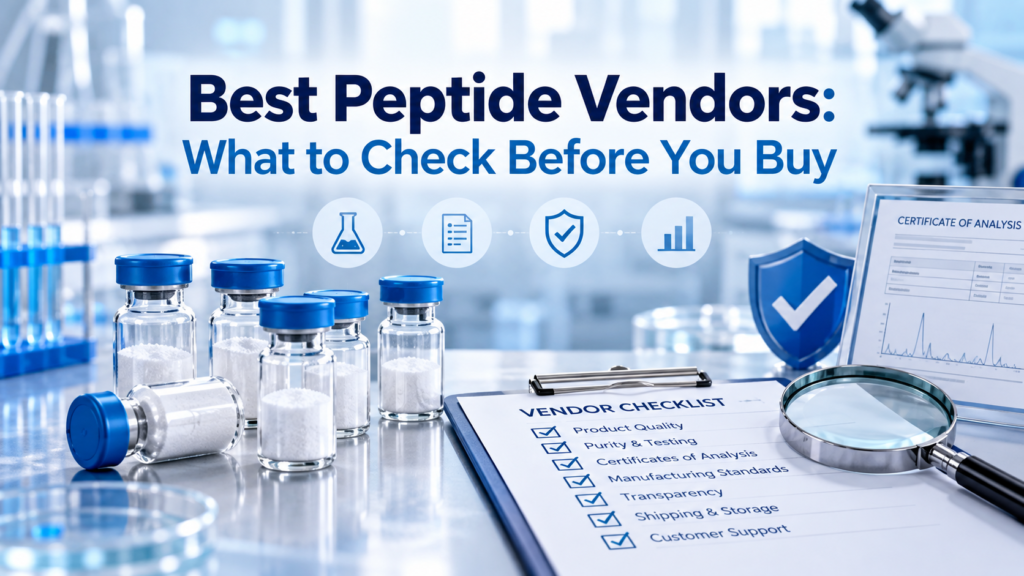
A Certificate of Analysis is only meaningful if the lot number matches the vial you received, and if it includes the actual chromatogram and mass-spec data behind the stated purity figure, not just a bare percentage. This site’s full COA-reading guide covers this in detail. Given that Paradigm Peptides’ fraud specifically involved forged COAs, this is not a theoretical concern.
A lab name on a document isn’t verification. Check for accreditation you can confirm independently (A2LA, ISO/IEC 17025) rather than a logo printed on the COA itself.
A 5.0/5 rating built on a small number of reviews tells you less than a lower but consistent rating built on hundreds of reviews over years. Independent audits sometimes diverge sharply from aggregate review-site scores. One vendor commonly cited as a top pick carries a perfect score on one review aggregator but ranks #15 of 55 vendors on a separate, more rigorous independent audit that specifically flagged the absence of ISO/IEC 17025 documentation and sterility testing in its COAs. Neither number is necessarily wrong; they’re measuring different things. Check more than one source.
FDA enforcement in this category, including the Amino Asylum and Paradigm Peptides cases above, consistently centers on the gap between “research use only” labeling and marketing that actually targets human use. A vendor’s own marketing language, not just its disclaimer footer, is itself a signal worth reading.
Peptide Sciences had operated for over a decade before shutting down overnight. Longevity reduces some risks but doesn’t eliminate the possibility of an abrupt closure with no refund process. No single criterion above is sufficient by itself; use them together.
In the interest of transparency: Core Power Peptides is the company publishing this guide, and we’re describing our own practices the same way we’d describe anyone else’s, not claiming to be ranked first. Core Power Peptides states that its research materials are tested by HPLC/UV and LC-MS for purity and identity, with LAL endotoxin testing, produced in an FDA-registered US facility. As with any vendor, including this one, verify the specific batch’s Certificate of Analysis against the vial you actually receive, lot number included, rather than taking a product description on faith. That check matters for every vendor in this market, not as a formality.
Rather than asking you to trust one more “best of” list, including this one, these are places where evaluation happens outside any single vendor’s control:
Cross-referencing two or three of these against the criteria above will tell you more than any single ranked list, including this article.
| Red Flag | Why It Matters |
|---|---|
| COA purity stated with no chromatogram or mass-spec data | A number with no underlying evidence is a claim, not a result |
| Lot number on the COA doesn’t match the vial label | The exact fraud pattern documented in the Paradigm Peptides case |
| Marketing language describes dosing “for” a human condition rather than research parameters | The specific pattern behind recent FDA enforcement in this category |
| No independent, verifiable lab accreditation | A stated lab name isn’t the same as a verifiable one |
| Reviews are recent, numerous, and suspiciously uniform | Can indicate incentivized or fabricated review activity rather than organic customer feedback |
No source claiming this should be taken at face value, including this one. Independent audits and review aggregators frequently disagree with each other, sometimes sharply, because they measure different things. Check a vendor against the specific criteria in this guide rather than relying on any one ranking.
Amino Asylum’s warehouse was raided by the FDA in June 2025 after the company allegedly ignored prior warning letters and marketed products for human use. Peptide Sciences shut down voluntarily and without explanation in March 2026 after over a decade in business. Paradigm Peptides’ owner was sentenced to nearly six years in federal prison in 2026 for selling unapproved, mislabeled drugs and forging Certificates of Analysis.
Check that the lot number matches your vial, that the stated purity is backed by an actual chromatogram, that mass spectrometry data confirms identity, and that the testing lab can be independently verified. This site’s COA guide walks through each of these in detail.
No. This guide describes Iron Peptides’ stated testing practices factually, discloses that Iron Peptides is the publisher, and encourages checking any peptide vendors, including this one, against the criteria described above rather than taking a self-published ranking at face value.
