
Tesamorelin holds a distinction no other compound in its class can claim: it is the only FDA-approved GHRH analog, cleared under the brand name Egrifta in 2010 for HIV-associated lipodystrophy. That approval came with a Phase 3 dataset far deeper than most research peptides ever accumulate, which is why tesamorelin is frequently used as the reference GHRH agonist when an established comparator is needed.
Tesamorelin is a synthetic analog of growth hormone-releasing hormone (GHRH) consisting of the full 44-amino acid sequence of human GHRH with a trans-3-hexenoic acid group added to the N-terminus. Developed by Theratechnologies, it is the only FDA-approved GHRH analog — approved under the brand name Egrifta® for HIV-associated lipodystrophy in 2010. Beyond its approved indication, tesamorelin has attracted substantial research interest for its effects on body composition, metabolic function, and age-related growth hormone decline.
Unlike direct GH replacement, tesamorelin preserves the pulsatile pattern of endogenous GH secretion, a pharmacological advantage that researchers consider important for mimicking physiological conditions in study designs.
Tesamorelin activates GH secretion through the hypothalamic-pituitary axis:
Phase 3 trials leading to FDA approval demonstrated robust effects:
Studies in healthy older adults (60+ years) have investigated tesamorelin for somatopause:
| Study Context | Dose | Frequency | Duration |
|---|---|---|---|
| FDA-approved (lipodystrophy) | 2mg | Daily SC | 26+ weeks |
| Aging/cognitive research (human) | 1–2mg | Daily SC | 20–26 weeks |
| Rodent models | 100–300 µg/kg | Daily SC | 4–12 weeks |
Research reference only. Not dosing guidance for human use.
| Parameter | Tesamorelin | CJC-1295 (Without DAC) |
|---|---|---|
| Sequence | Full GHRH (44 aa) + trans-3-hexenoic acid | Modified GHRH 1-29 (30 aa) |
| FDA approval | Yes (Egrifta — HIV lipodystrophy) | No |
| Half-life | ~26 minutes | ~30 minutes (without DAC) |
| Clinical data depth | Extensive (Phase 3 + approval) | Phase 1/2 only |
| Primary use in research | Lipodystrophy, aging, cognition | GH secretion, body composition |
When sourcing tesamorelin for laboratory research, evaluate suppliers on:
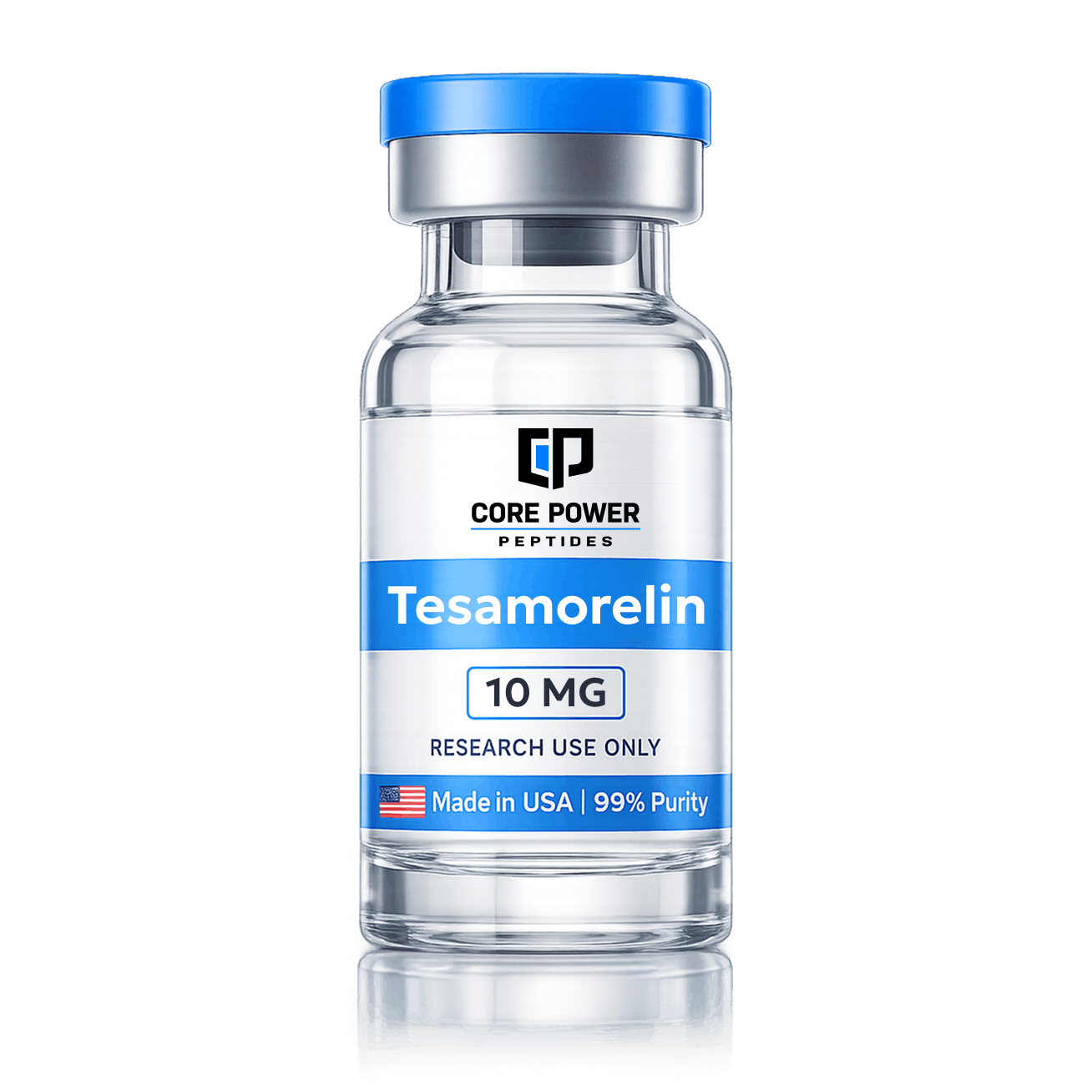
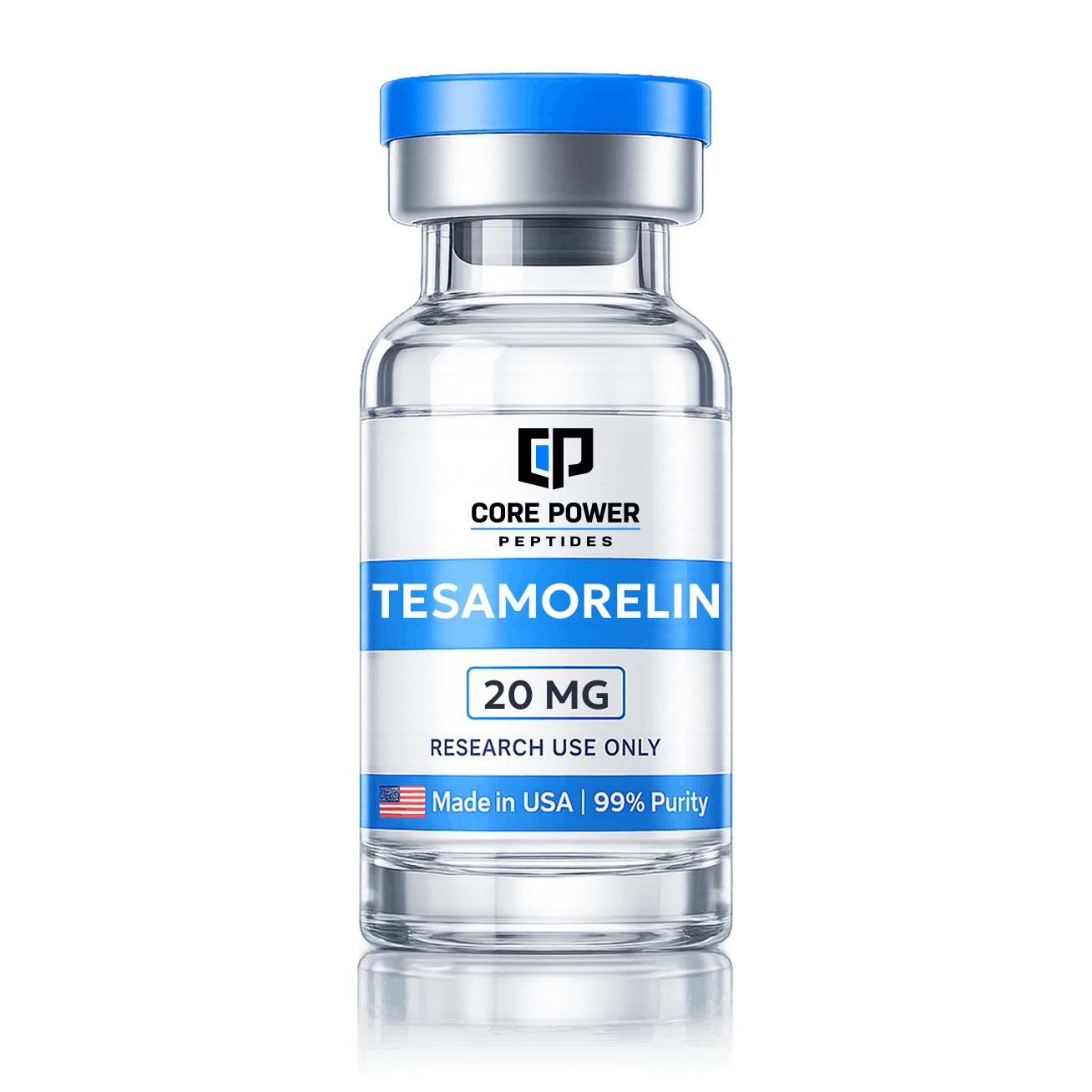
Tesamorelin enhances the amplitude of endogenous GH pulses rather than producing continuous supraphysiological levels. For researchers modeling physiological conditions that distinction matters — direct GH replacement flattens the natural secretion rhythm, while a GHRH analog works through the hypothalamic-pituitary axis and leaves pulsatility intact.
Both are GHRH analogs acting at the same pituitary receptor, but tesamorelin is the full 44-residue sequence carrying a stabilizing N-terminal modification, while sermorelin is the truncated GRF(1-29) fragment. The tesamorelin vs sermorelin comparison covers the structural and stability differences in full.
Regulatory depth is the clearest difference — tesamorelin has completed Phase 3 and holds FDA approval, while CJC-1295 has Phase 1/2 data only. Half-lives are broadly comparable at roughly 26 and 30 minutes respectively for the non-DAC forms.
Compiled for educational and scientific reference. Tesamorelin from Core Power Peptides is supplied for in vitro and laboratory research exclusively — not for human consumption and not medical advice. Researchers are responsible for compliance with applicable local regulations.
